
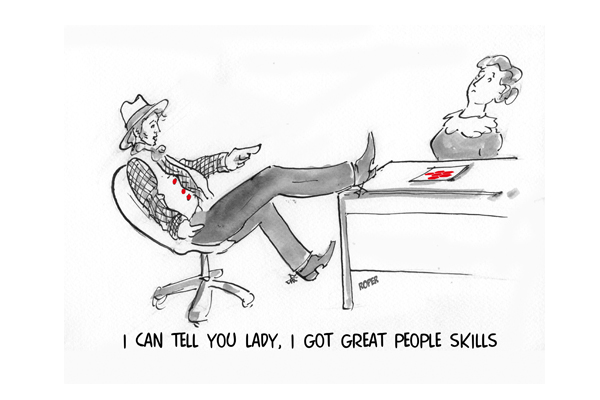
Most people get promoted because they’re good at what they do. They’re technically strong. Commercially capable. Trusted by clients. Reliable under pressure.
In the early stages of your career, that’s usually enough.
If you’re a lawyer, accountant, surveyor, recruiter or business owner, your success initially comes from your ability to deliver the work itself. You know your craft. People value your expertise. Clients want to work with you.
But then something changes. Your role becomes less about doing the work personally, and more about getting results through other people.
And that’s the point where many capable professionals begin to struggle, not because they lack intelligence or commitment, but because the skills that made them successful up to that point are no longer sufficient on their own.
The missing category of skills
Most people recognise two types of skills at work.
First, there are your technical skills:
- your professional expertise
- your specialist knowledge
- your ability to deliver the work
Second, there are your social skills:
- building rapport
- influencing people
- being likeable and personable
- maintaining relationships
If you work in a client-facing role, chances are your social skills are already well developed. Your clients trust you. You communicate well. You know how to build goodwill and put people at ease.
The problem is that many leaders assume these two sets of skills are enough. They aren’t.
Because there is a third category of skills that becomes critical as organisations grow – and very few people are ever formally taught it.
I’d describe these as professional working skills.
Why social skills alone stop working
This is where things often become uncomfortable.
Many leaders try to manage workplace issues using the same skills they use socially.
- If someone in the team is unhappy, they take them out for lunch.
- If collaboration is poor, they organise drinks or a team-building day.
- If tensions rise, they try to “keep everyone happy”.
Sometimes it helps, but often it doesn’t, because social closeness is not the same thing as having effective professional working relationships.
It can even make certain things harder.
How do you:
- hold someone to account when you’re trying to be their friend?
- challenge poor performance without damaging the relationship?
- make difficult decisions when everybody expects you to be “nice”?
This is where many growing businesses get stuck – the organisation becomes emotionally complicated because people haven’t developed the skills needed to work together clearly and professionally under pressure.
The challenge becomes greater as organisations diversify
This issue is even more important now than it was a decade ago. You can no longer assume everybody interprets communication, feedback, accountability or authority in the same way.
And this is where relying purely on charisma or “being good with people” starts to break down.
Because what actually matters is not whether people like each other socially.
It’s whether they understand:
- how to communicate professionally
- how to resolve issues constructively
- how to hold each other to account
- and how to work together effectively even when things are difficult
What strong professional working relationships actually look like
Healthy organisations are not built on everybody being best friends, but on clarity.
People know:
- what is expected of them
- how decisions are made
- how to raise concerns
- how to disagree productively
- how accountability works
- and how to communicate under pressure
This creates trust of a much more durable kind than simple social chemistry.
In fact, ironically, teams where people are not naturally close socially often perform extremely well because they have had to develop explicit agreements about how they will work together.
They cannot rely on goodwill and unspoken assumptions, so they create clarity instead – and clarity endures far better than personality.
The leadership shift most growing businesses need
As your organisation grows, your role as a leader changes fundamentally.
You are no longer simply the expert, the problem-solver or the person everybody likes. Your role becomes creating an environment where people can work together effectively, even under pressure, across differences and without constant intervention from you.
It requires more than technical excellence and social confidence; it requires deliberate professional working disciplines.
Practical questions worth asking yourself
As your business grows, ask yourself:
- Do people in our organisation know how to hold each other to account professionally?
- Are difficult conversations avoided because relationships are too socially entangled?
- Have we made our expectations and ways of working explicit?
- Do managers in the business actually know how to manage performance?
- Are we relying too heavily on personality instead of clarity?
Because the organisations that scale successfully are rarely the ones where everybody gets on socially all the time.
They are the ones where people know how to work together well.
And there’s a big difference between the two.