
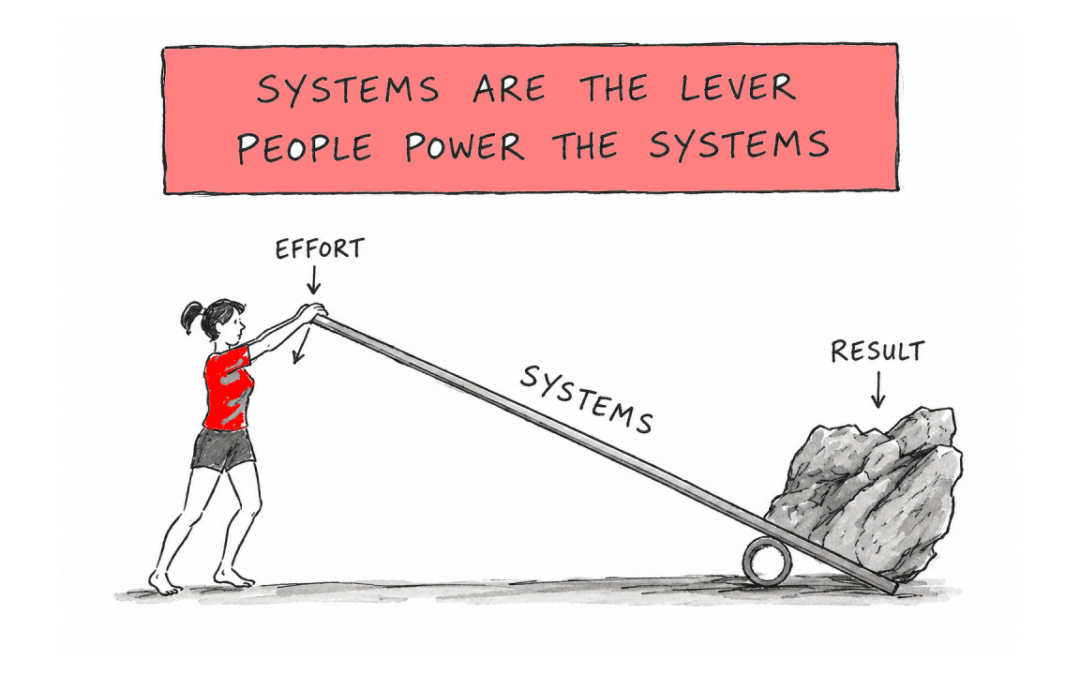
When a business starts to creak under the strain of growth, many founders instinctively look for a better system – a new CRM, a better project management platform or a more sophisticated finance package.
In short, a workflow tool that promises to automate everything!
There’s nothing wrong with any of those investments. In the right circumstances, they’re exactly what’s needed.
The problem is assuming that technology will solve what is actually a leadership challenge.
The temptation to engineer your way out
Many business owners built successful careers because they were good at solving technical problems.
- Engineers engineer.
- Accountants analyse.
- Lawyers create process.
- IT specialists automate.
When the business becomes more complicated, it’s natural to reach for the skills that have always served you well.
But organisations don’t only become more complex because of the work they do. They become more complex because of the people who do it – and people are far less predictable than software.
Systems don’t create accountability
I’ve seen businesses spend tens of thousands of pounds implementing sophisticated systems, only to discover that the same problems keep resurfacing. Projects still slip, decisions still stall, people still duplicate work – and customers still experience inconsistency.
The software worked exactly as designed; the organisation didn’t.
That’s because no system can compensate for unclear roles, confused priorities or managers who aren’t confident about making decisions.
Technology supports good organisation design, it doesn’t replace it.
A familiar story
One client – a rapidly growing professional services firm – decided it had outgrown its simple invoicing process.
Invoices had always been raised quickly by the people closest to the client. It wasn’t particularly sophisticated, but it worked. Clients received invoices promptly, queries were rare and cash flow was healthy.
As the business expanded, the leadership team decided it was time to become “more professional”, and introduced a centralised finance system.
Invoice requests had to pass through multiple stages. Approvals were added and workflows were automated. On paper, everything looked far more robust.
In reality, invoices took weeks longer to reach clients. Queries increased because the finance team had less context than the people doing the work. Cash flow deteriorated and everyone became frustrated.
The software wasn’t at fault.
The leadership team had assumed that a bigger business automatically required a more complicated process.
It didn’t.
Complexity isn’t maturity
One of the biggest myths in growing businesses is that maturity looks like complexity.
It doesn’t. The best scale-ups are often remarkably simple: clear roles, straightforward decision-making, short communication lines, and processes that are only as complicated as they need to be.
Every additional approval, report, meeting or workflow should earn its place.
If it doesn’t make the organisation clearer, faster or more accountable, why is it there?
Your job has changed
Perhaps the biggest shift for founders isn’t learning new systems, it’s recognising that their role has changed.
In the early days, success comes from solving technical problems quickly.
As the business grows, success depends much more on designing an organisation where other people can solve those problems without constantly referring back to you.
That requires a different set of skills:
- Creating clarity.
- Building capable managers.
- Developing shared expectations.
- Shaping culture.
- Helping people make good decisions.
These skills are less tangible than implementing a new piece of software, which is precisely why so many founders postpone them.
But they’re also the things that determine whether the business can continue to grow.
Build the organisation before you buy the technology
I’m certainly not arguing against systems – good technology can save enormous amounts of time and improve consistency. But it should support a well-designed organisation, not compensate for one that lacks clarity.
Before investing in the next software platform, ask yourself a different question.
Are we trying to solve a systems problem – or are we trying to solve an organisational one?
The answer may save you a great deal of money – and a great deal of frustration.