
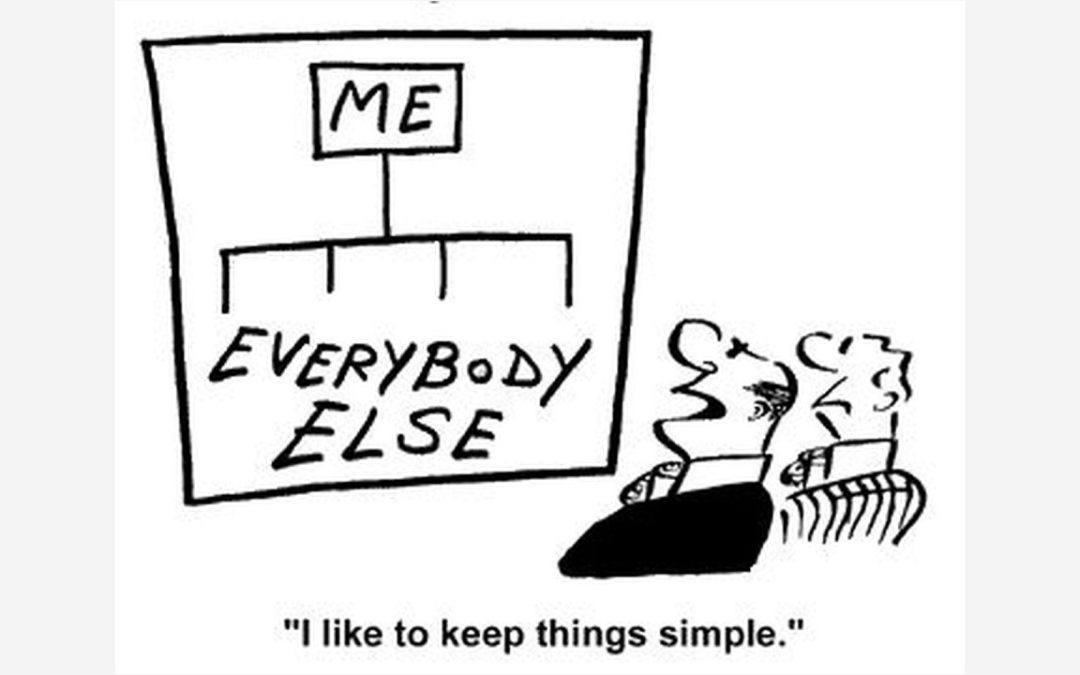
Many founders I work with started their careers in large organisations before deciding to strike out on their own.
They were tired of bureaucracy. Endless reporting, layers of management and processes that seemed to exist for their own sake. Decisions taking weeks instead of hours.
So they made themselves a promise, “When I run my own business, it won’t be like that.”
It’s an understandable reaction. In fact, it’s often one of the reasons people become entrepreneurs in the first place.
The problem is that, in rejecting unnecessary bureaucracy, some founders also reject the simple structures that allow an organisation to grow – and that’s where the trouble begins.
When informality works
In the early days, very little needs to be formal.
Everyone knows everyone else. The whole team can gather around one table. Conversations happen naturally because everybody can hear what’s going on.
Problems are spotted quickly. Decisions are made in minutes. People pitch in wherever they’re needed.
It feels wonderfully agile, and more importantly, it works.
But it works because the business is small, not because informality is somehow a superior way of organising people.
Growth changes the rules
As the business grows, the founder often starts to notice that something has changed.
Communication isn’t quite as smooth. People duplicate work without realising it. Decisions slow down, and tasks fall between the cracks because everyone assumed someone else was doing them.
People get frustrated with each other.
The founder’s instinct is often to blame the symptoms. Perhaps, they think, everyone needs to sit together again. Or perhaps the team just needs another social event. Might communication improve if people simply talked to one another more?
None of those things are necessarily bad ideas. But they rarely solve the real problem, because the organisation itself has changed. The informal systems that worked perfectly for ten people simply don’t scale to thirty, fifty or a hundred.
The founder becomes the communication system
This is the point where many businesses accidentally create a dependency on the founder.
Because nobody is completely clear where decisions sit, people ask the founder.
Because roles overlap, the founder resolves the disagreements.
Because priorities aren’t fully aligned, the founder becomes the person who joins everything together.
Without meaning to, the founder becomes the organisation’s operating system!
It feels as though everyone is busy – the founder certainly is – but the business is becoming increasingly dependent on one person to make it function. It’s exhausting for the founder and frustrating for everyone else.
Structure isn’t bureaucracy
This is where many founders become nervous; they hear words like structure, process and management, and immediately picture the corporate environment they were so keen to leave behind.
But good organisational design isn’t about adding bureaucracy, it’s about removing ambiguity.
People need to know what they’re accountable for and managers need clarity about who they’re leading.
Teams need regular opportunities to coordinate, solve problems and make decisions together.
People need meaningful one-to-ones that help them succeed, not annual appraisal forms that nobody enjoys completing.
None of this is complicated – in fact, done well, it’s remarkably simple.
There is a world of difference between bureaucracy and structure: one gets in people’s way, the other helps everyone move in the same direction.
The purpose isn’t to control people: it’s to make it easier for capable adults to do great work without constantly relying on the founder.
Build the organisation your business now needs
One of the biggest challenges for growing businesses is recognising that every stage of growth requires a different way of organising. The practices that helped you succeed as a start-up won’t necessarily help you become a successful scale-up, and what works with twenty people won’t be enough when there are sixty.
That’s not failure: it’s growth.
The founders who navigate this transition successfully aren’t the ones who build the most elaborate organisations.
They’re the ones who introduce just enough clarity, accountability and communication to match the complexity of the business they’ve become.